

HOPE FOR PEACE
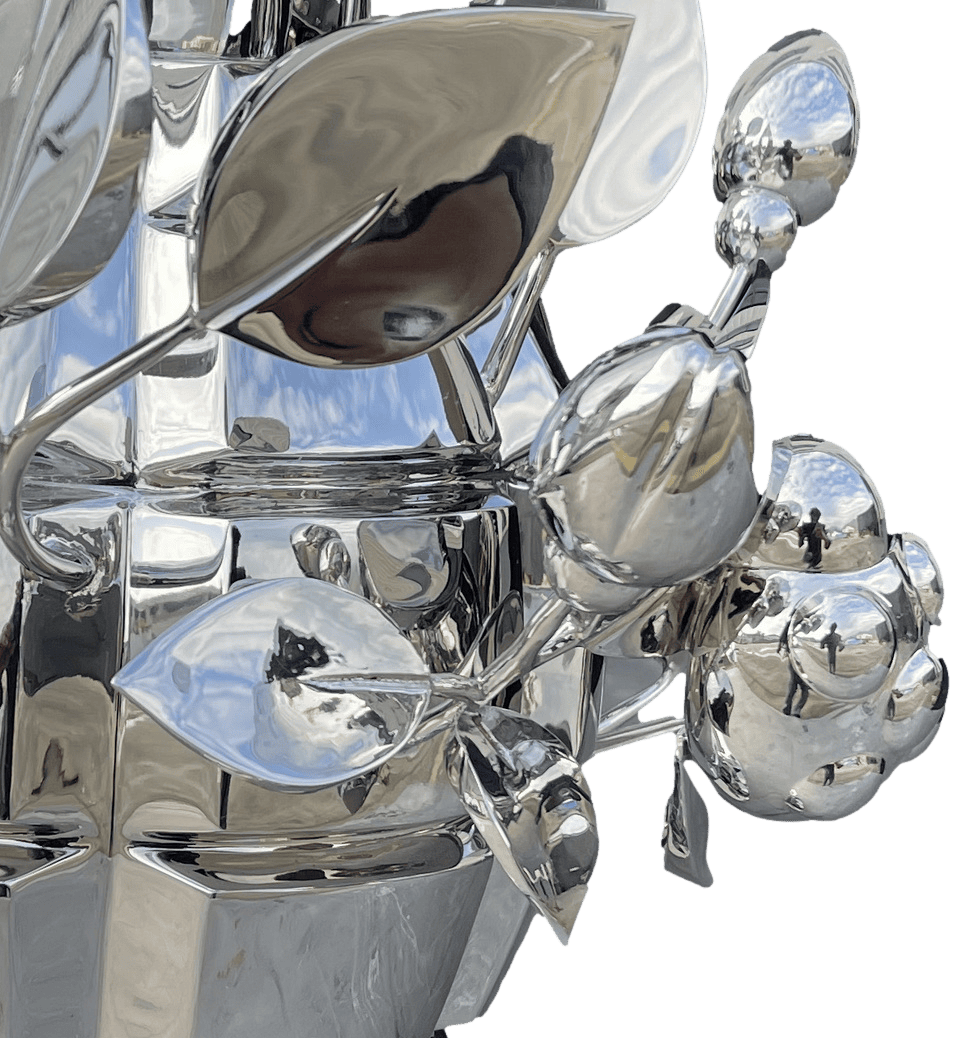


DETAILS
La Grenade
Créée en 2020, cette sculpture précède les conflits qui bouleversent aujourd’hui notre monde et qui ont depuis pris une ampleur dramatique, notamment en Ukraine, en Iran et en Israël.
Elle raconte l’histoire d’une grenade abandonnée dans une forêt. Lentement, la nature reprend ses droits : branches, feuilles et fleurs l’envahissent, l’enserrent et l’emprisonnent, jusqu’à la rendre définitivement incapable d’exploser.
Les fleurs sont encore fermées, comme suspendues dans le temps. L’arme, entièrement captive de cette végétation, est devenue inoffensive. Ici, la nature ne détruit pas : elle désarme.
Une coccinelle s’est posée sur les feuillages. Ce détail minuscule est pourtant essentiel au récit de l’œuvre. Surnommée en français « la bête à bon Dieu », la coccinelle est depuis des siècles associée à la protection, à la chance et à l’espoir.
Selon une légende médiévale, alors que les récoltes étaient ravagées par les insectes, les paysans prièrent le ciel de leur venir en aide. Des coccinelles apparurent en grand nombre et dévorèrent les parasites, sauvant les cultures. De cette intervention providentielle serait née l’expression « bête à bon Dieu ».
Une autre légende raconte qu’un innocent condamné à mort fut sauvé par une coccinelle. Au moment de l’exécution, l’insecte se posa sur son cou. Le bourreau l’écarta, mais elle revint obstinément au même endroit. Le roi y vit un signe providentiel et suspendit l’exécution. Peu après, le véritable coupable fut découvert et l’innocent fut libéré.
Dans cette sculpture, la coccinelle devient ainsi un symbole fragile mais obstiné de paix et d’espoir. Face à la violence créée par l’homme, la nature oppose une force silencieuse : elle enveloppe l’arme, l’immobilise et la condamne au silence.
La grenade n’explosera jamais. La nature l’a désarmée. Et sur elle, une simple coccinelle veille encore.
The Grenade
Created in 2020, this sculpture predates the conflicts that now shake our world and have since grown to devastating proportions, particularly in Ukraine, Iran, and Israel.
It tells the story of a hand grenade abandoned in a forest. Slowly, nature reclaims it: branches, leaves, and flowers spread across the weapon, encircling and imprisoning it until it is forever incapable of exploding.
The flowers remain closed, as though suspended in time. Completely captive within the vegetation, the weapon has become harmless. Here, nature does not destroy: it disarms.
A ladybug has settled among the leaves. Tiny as it is, this detail is essential to the story of the work. In French, the ladybug is affectionately known as la bête à bon Dieu — “God’s little creature” — and has long been associated with protection, good fortune, and hope.
According to a medieval legend, when crops were being devastated by insects, farmers prayed for divine help. Ladybugs then appeared in great numbers and devoured the pests, saving the harvests. This providential intervention is said to have inspired the ladybug’s affectionate French name.
Another legend tells of an innocent man condemned to death who was saved by a ladybug. At the moment of his execution, the insect landed on his neck. The executioner brushed it away, but it persistently returned to the same spot. The king interpreted this as a providential sign and halted the execution. Soon afterwards, the true culprit was discovered and the innocent man was set free.
In this sculpture, the ladybug becomes a fragile yet steadfast symbol of peace and hope. In the face of violence created by humankind, nature answers with a silent force: it embraces the weapon, immobilizes it, and condemns it to silence.
The grenade will never explode. Nature has disarmed it. And upon it, a single ladybug still keeps watch.